


-
☯I Ching Basics
-
☯Consulting I Ching
-
☯Chinese Zodiac
-
☯I Ching Resources
-
If you like our web site and find it useful - donate with PayPal to support new development
I Ching Readings:
Family Tension – Can Harmony Be Restored?
The Situation
Tora recently got married and entered a new family environment. Over time, tension began to build between her and her in-laws. She senses that something can be improved - but she does not know how.
She asks: “Our family relationships are deteriorating. Is there anything that can be done before it is too late?”
The I Ching answers Tora with (#37, 6):
Hexagram #37 with 6th line moving. She asked for help interpreting her casting.
Primary Reading Structure
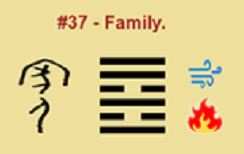
- Primary Hexagram: #37 – Family (Household, Clan, Harmonious Family, Proper Relationships).
- Moving Line: Line 6
- Target Hexagram: #63 – After Completion
Mainstream Interpretation (Practical Guidance)
You are now part of a system that already exists - a family with its own structure, roles, and expectations. The tension you feel is not unusual. It is a natural result of change within a closed system.
Hexagram #37 reminds you:- Every family depends on balance of roles and mutual respect
- Harmony is not automatic — it must be built and maintained
- Harmony is possible
- But only through careful, steady adjustment
What this means for you:
- Do not rush to fix everything at once
- Focus on understanding roles rather than changing them immediately
- Build trust gradually
Simple guidance:
- Don’t try to win the situation.
- Help the system stabilize - and you will naturally find your place in it.
Advanced Interpretation (Structural View)
Now we move from advice to system behavior.
Hexagram #37 – Family.
This is a closed, role-based system.
Key structural properties:
- Defined hierarchy
- Interdependent roles
- Stability depends on correct positioning
Core Dynamic:
Hold together, support each other - members of family are comforted by the inner spirit of each family member.Symbolic Structure → Practical Meaning
World of Trigram Symbols
In trigram terms, Wind over Fire shows that communication (Wind) directly amplifies emotional dynamics (Fire). Structurally, this explains why small words or tone shifts can quickly intensify family tension in this situation.World of Digram Symbols
The digram structure reflects an established 3-Layer family hierarchy (Husband–Wife–In-Laws), where newer members align under existing authority. This reinforces the core structural tension: Tora is entering a system where roles already exist and are not easily renegotiated. Tora’s entry introduces:- A new element into an already balanced structure
- Redistribution of emotional and relational roles
Moving Line 6 (Top Line)
This is critical. Line 6 represents:- The outer boundary of the system
- The visible expression of internal harmony (or lack of it)
- The issue is not just internal—it is visible in behavior and interactions
- The system is being evaluated at its highest level of cohesion
Transition to #63 – After Completion
This is one of the most misunderstood outcomes. #63 does NOT mean “everything is perfect.” It means:- The system has reached correct alignment
- But becomes highly sensitive to disturbance
Structural Insight
- You are moving toward stability
- But stability here requires precision, not force
Expert Interpretation (Deep System View)
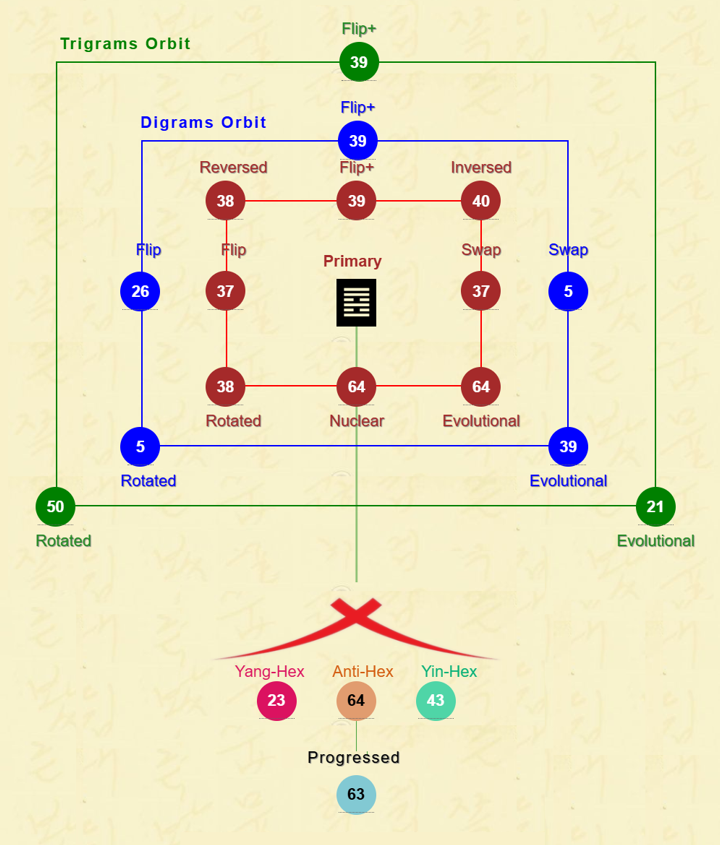
Now we examine the full transformation architecture.1. Nuclear Hexagram: #64 – Before Completion
This is the hidden core of the situation. Beneath the appearance of “family structure,” the system is actually:- Incomplete
- Still forming
- Not yet stabilized
The situation looks like #37 (established family).
But internally behaves like #64 (not yet complete).
Deep Insight
You are not entering a finished system - you are entering the one still negotiating its final form. You are entering a system that is:- Reorganizing itself
- Testing new balance points
- Not yet settled into its final form
2. What the Situation Is NOT
Inverse Opposite: #40 – Deliverance This is not a situation where:- Problems are released quickly
- Tension disappears easily
Reverse Opposite: #38 – Opposition
This is also not a true conflict situation. → The tension is structural, not adversarial.Combined Meaning
- Not quick resolution (#40)
- Not true opposition (#38)
- Monogram-rotated #38 - Opposition,
- Digram-rotated #5 - Waiting and
- Trigram-rotated #50 - The Great Bowl.
A second structural shift appears in digram rotation. For Family situation, 3 digrams represent 3 important structural bones of family structure: husband, wife and in-laws.
When the top digram is moved to the base, the system resolves into #5 – Waiting.
The implication is structural: progression halts when relational order is inverted. Consider how this applies to the current family dynamic.Similarly, when swapping top and bottom trigrams (Heaven and Earth), the Family hexagram resolves to #50 - The Great Bowl, advising us to learn a family wisdom and not to try going alone at this time.
To extend this reflection, and to complete the list of structural patterns in Family situation consider these Evolutional forms:- Monogram Evolutional hexagram: #64 - Before Completion,
- Digram Evolutional: #39 - Obstruction and
- Trigram Evolutional hexagram #21 - Biting Thru
Movement Dynamics (Single Moving Line)
Because there is one moving line, the system shows:- Focused transformation
- A single pressure point
3. Transformation Set (Expanded System View)
Because a moving line exists, the reading expands into additional transformation structures:- Yang-Transformed: #23 – Splitting Apart → active structural reduction
- Yin-Transformed: #43 – Break-Through → receptive emergence of decisive clarity
- Anti-Hexagram: #64 – Before Completion → directional exclusion (what will not occur)
- Final Target Hexagram: #63 After - Completion → stabilization endpoint
Anti-Hexagram: #64 – Before Completion
The Anti-Hexagram represents the path the system is actively not yet taking. This is highly important. #64 represents:- Instability before resolution
- Incomplete transition
- Premature movement toward uncertain outcomes
Implication
The system does not support:- chaotic transition
- rushed conclusions
- unfinished restructuring
- proper sequencing
- internal preparation
- stabilization of fundamentals
Yang Transformation: #23 – Splitting Apart
The Yang or Energy Operator describes the actions through which change occurs. #23 indicates:- removal of weakened structures
- gradual elimination of what no longer supports growth
- reduction of unstable foundations
- what has become unsustainable
- what must be released
- what can no longer continue unchanged
Yin Transformation: #43 – Break-Through
The Yin or Context Operator describes the environment where change unfolds. Hexagram #43 – Break-Through reflects:- decisive internal realization
- emergence of truth as a structural clarity
- necessity of clear communication
- cutting through personal emotional confusion
- confront underlying realities directly but carefully
4. Target Hexagram: #63 – After Completion
This is a high-order equilibrium state. Key properties:- All elements are in correct position
- Balance is achieved
- But stability is fragile
System-Level Meaning
You are moving toward:- A fully integrated family structure
- A stable relational pattern
- Precision
- Awareness
- Patience
Critical Warning
Hexagram #63 always carries an implicit message: “Now that balance is achieved - do not disturb it carelessly.”5. System-Level Conclusion
This is a stabilization process, not a correction process.- The system is not broken
- It is reorganizing toward equilibrium
Reading Summary
Entering a new family always creates change. What you are experiencing is not failure — it is rebalancing. The I Ching shows:- The system is still forming (#64)
- It is not in conflict (#38)
- It cannot be rushed (#40)
- It is moving toward stable harmony (#63)
- Observe before acting
- Adjust before asserting
- Build trust before expecting resolution
Post-Scriptum (Outcome)
Tora approached the situation differently after the reading. Instead of trying to resolve tensions directly, she:- Focused on understanding family dynamics
- Adjusted her responses rather than confronting others
- Allowed relationships to evolve gradually
- Tension decreased naturally
- Roles became clearer
- Trust developed without force